Black Holes
Foreword
The very concept of black holes has always fascinated me. I think my interest in them started with movies like Event Horizon (would not recommend watching as a small child) and Lost in Space as well as books like Singularity. This, of course, was compounded by watching and reading lots of educational content on them over the years as a kid.
More recently, movies like Interstellar brought a lot of attention back to black holes as a intriguing, mysterious celestial objects. I’d recommend The Science of Interstellar if you’re interested in a bit of light reading on the subject, especially if you’re a fan of the movie.
I feel like there’s a certain sense of dread associated with black holes being that they’re so extreme even on the cosmic scale and difficult to fully grasp.
History
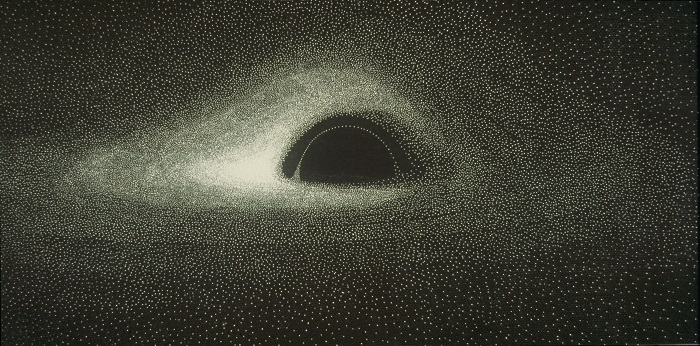
The first simulated image of a black hole was made in 1978 by Jean-Pierre Luminet.
The Event Horizon
Not to be confused with the movie Event Horizon, the event horizon of a black hole is the boundary at which all future paths in the light cones of particles will take you closer to the black hole itself. Another way to think about it is that the boundary delineates where the escape velocity from the black hole becomes greater that the speed of light (c).
The radius of the event horizon for a non-spinning, uncharged black hole, i.e. a Schwarzschild black hole, can be found using: .
Note that there are also event horizons in other contexts.
Mass Classes
There are several different classes of black hole that are categorized by their mass.
| Class | ~ Mass | ~ Radius |
|---|---|---|
| Ultramassive black hole | 109–1011 M☉ | >1,000 AU |
| Supermassive black hole | 106–109 M☉ | 0.001–400 AU |
| Intermediate-mass black hole | 102–105 M☉ | 103 km ≈ R |
| Stellar black hole | 2–150 M☉ | 30 km |
| Micro black hole | up to M | up to 0.1 mm |